| Orthodox Outlet for Dogmatic Enquiries | Holy Bible |
|---|
The use and the value of parables
Transcript of a homily by the blessed Elder Athanasios Mytilineos
(Homily delivered at the Holy Monastery of Komnenos in Larissa on
11-10-1998
|
Today, my beloved, we heard the parable of the Sower, by which
the Lord wanted to show His listeners that not everyone is
equally disposed towards His teaching. And with this parable, He
was also showing them that there were four categories of
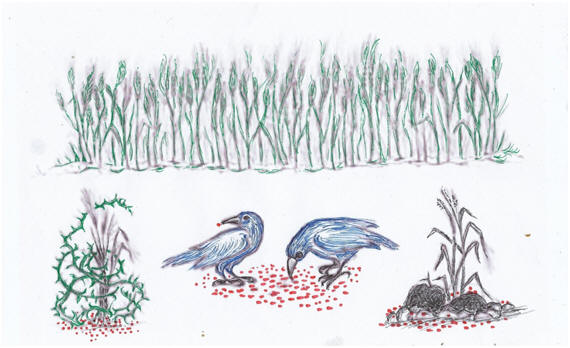
listeners: “The seed fell”, He says, “on stones , and because it did not find any moisture, it sprouted but then it dried up.” Those who have a shallowness, and those who are frivolous and the cares of this life do not allow them to develop the spiritual life, refer to the seed that had fallen among thorns or on the roadside.
But, fortunately, there is also the “good soil”
- which is the benevolent heart – “where the seed
fell”, He says, “and yielded a
hundredfold”. One notices that a crowd of people gathered - as Luke and Matthew note for us - at the preaching of Christ. Luke says: “And a great crowd having gathered, also by those who had walked to Him from every other city, He spoke to them with a parable...” etc. So, there was a great multitude of people...the presence of a great multitude that had gathered... But why did the Lord speak to them with a parable? It was a custom of the Lord to speak in parables. A parable is a small - ficticious but within reality - narration, which has differing and various purposes. I said “within reality” : for example, in one of Aesop's fables (or parables) it says that a raven was holding a piece of cheese in its beak, and the fox (who longed to snatch the cheese) said to the raven: 'Ah, how beautifully you sing...' - . This is not a feasible scenario, as neither the fox can speak, nor can the raven. Consequently, these are myths or images or parables that cannot reflect actual events. Whereas all the parables of Christ may be imaginary stories, but they are nevertheless feasible - they can be actualized by people.
A parable is an internal overseeing method that elucidates the
concept. Pay attention
to this detail. Mark says: “...and without a parable
He would not speak to them.”
Without a parable, He never spoke to the crowds...
So, when He said, “Beware
of all covetousness”, He was stating a certain
meaning, but He would then elucidate it, with a parable on the
dangers for the one who is greedy - hence narrating the parable
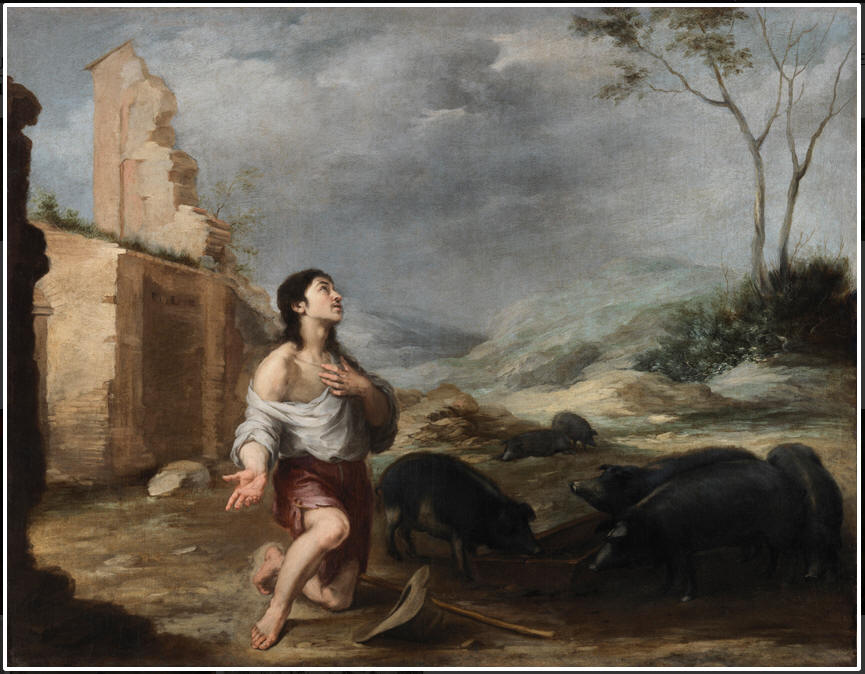
of the foolish rich man. Or, in the desire to portray the magnitude of the event of salvation and the magnitude of a sinful person's desire for salvation - and if it is acceptable by God - He had narrated three parables. He told the parable of the lost coin (drachma), of the lost sheep, but also of the prodigal son. You can see that the Lord expounds an example on morality or on faith and then continues with a parable. Why? To elucidate what He had previously said.
The parable itself has an apparent weakness in that it does not
give any definitions. If
you like, pay attention to this detail: a definition defines
pertinent details; or, in other words, it confines. It places
boundaries on what it wants to say. The definition of justice...
the definition of truth etc... What
are these “definitions”? They are just
a couple of words that
pertain to the subject, but they also confine the subject within
certain boundaries; beyond
those boundaries, we cannot say anything. That is what is meant
by “defining”. And it is
well known that we have definitions for very many things.
The ancient Greeks
especially loved to define things;
they would always formulate definitions.
We say that “God is in-definite” - in other words, He cannot be
defined. Indeed, what
could we say about God? We could say to define a table, that “it
has four legs, it has a flat surface...”, but what can we say
about God? God cannot be defined, because we cannot know God
more than what we “know” about Him. Consequently God is
in-definite. He cannot
be defined.
On the contrary, a parable expresses the richness of a meaning
that one can examine spherically – from this angle, from that
aspect, from another point... This
is the advantage that a parable has: whereas you can't say
anything additional
to define it, you can say many things to analyse and draw many
conclusions when a parable is narrated.
Thus we can say –
limitlessly - that: “this
and this is the meaning of the parable; this is also what it
implies; this is also what it signifies...”
without being hindered to limit the things that we can
extract from the parable..
The parable my beloved, is
also a comfortably abridged teaching. A teaching
with very few words.
With just one image it
can portray everything. In
our time, there is a saying that a photograph can “say” a
thousand things. For example, a photograph of an incident or an
event that is published, can display thousands of details that
cannot be provided by an editorial text.
We can claim this, even
in our day and age; likewise here, with the parable. The parable
is an all-encompassing image, in a succinct way – i.e., it is
what you could have explained differently, but with far too many
words. It has always
been a custom in the East - to this day, since ancient times –
for concise teaching through images which can always “speak
volumes”.
A parable is also a lesson worth memorizing - because it is easy
to remember - as it is adorned with imagery.
And when a lesson is
adorned with images,
with representations, one can retain them in memory very easily.
But at the same time, a
parable is also a goldmine from which - in the future, as a
person becomes educated and expands his knowledge - they can
draw more and more conclusions from within it – and I could say
to an inexhaustible degree. Whatever
a person may encounter, something new will inevitably arise in
their life, and when they resort to a parable, they will find a
detail that they needed, so then they can say: “See? It is what
the parable says”.
A parable can express the inexpressible. How can uncreated words
be expressed within this created cosmos? Only with a parable.
Thus, a parable is an image of divine realities, dressed
up with earthly garments.
Paul, for example, when swept up to the third heaven, had seen
and heard - as he himself tells us – “ineffable
words”. Words
that could not be expressed. And
he also said: “it is not
proper for man to utter” («οὐκ ἐξὸν ἀνθρώπῳ λαλῆσαι»)..
The Greek word “ἐξὸν” means
you are “not permitted to utter”, but also that you are “unable
to utter”. There is no way that you can phrase it.
So, Paul was “swept up to the third heaven”... to where? To
Paradise! So, Paradise -
the heavenly Paradise - is expressed here as a garden - a copy
of the Garden of Eden, which was down here, on Earth, and was
indeed a garden. But how can one clearly describe the heavenly
Paradise?
Furthermore, in order to speak of the Realm of God, the Lord
Himself says: “To what can I liken the realm of the
heavens? ” The
Lord here appears to find it difficult to describe - so to
speak. How can He liken the Realm of God?
“To what can
I liken it...” He says... so He narrated three
parables. He didn't say one. He told them three parables; in
each parable He could expound an aspect of God's Realm...
In other words, a
parable expresses the inexpressible. The created language - the
one we have (not the language of the tongue – the instrument of
speech), is poor and inadequate.
We see this in everyday life as well. How many times
haven’t we found it difficult to convey certain meanings from
one language to another, or to give a translation?
We can't achieve it
easily - let alone express things that are per se inexpressible.
Language, therefore, is extremely poor - human language, that
is... Regardless how
much we Greeks tout how rich the Greek language is. Well, yes,
versus other languages it is; but in reality, what can anyone
express about heavenly things?
Furthermore, a parable also differentiates between its
listeners. St. John the Chrysostom says:
“The parable
divides between the worthy and the unworthy.” It
divides, distinguishes, between the worthy and the unworthy.
And this is what takes
place here, in the present parable of the Sower. In the audience
there were the those who went to hear the Lord, but with what
disposition did they go to listen? Out of curiosity? We
encounter this possibility, as mentioned by the holy
Evangelists, on other occasions. Was it out of malice? Like the
Pharisees? Christ had never spoken anywhere in public, without
the ill-meaning Pharisees being present...
Did people go to hear
Him superficially? “Oh
well... let’s just go there and see..”
Or did people go to hear Him out of a genuine desire?
Here we can see that a parable can indeed differentiate between
the listeners.
A parable also - and this is very important - reveals and
conceals, clarifies and obscures. It does both - to both pairs.
It reveals, but it also
conceals. It is like the light that the Jews had in Egypt – with
sunlit days - when at the same time, because in the land of
Yeshem, a little to the southeast of where the Egyptians were,
there was a deep darkness. In fact, the sacred writer tells us
that the darkness was palpable. In other words, you had to grope
to discover something. The Jews had abundant light! This is what
a parable can also do: some listeners can perceive and others
can't. A parable
can clarify for most people, whereas for some it can obscure.
Listen to what Matthew writes:
“And when the disciples approached Him, they
asked (in fact during the parable of the Sower) "Why
do you speak to the crowds in parables?",
He replied: "to
you It has been given to know the mysteries of the realm of
heaven, but to them it has not been given”.
He said that it was given to the disciples to know the
mysteries of the heavenly realm, which however are intentionally
hidden within the cloak of a parable, or directly through
parables; whereas for the others – the many – that gift was not
given to them. “For
whoever does have that gift, it shall be in excess; but those
who do not have it, even that which they do have will be taken
away from them..”. In
short, even if you have a
little of the Spirit of God - if you have "special" eyes, you
will be given even more potential to discern. On the contrary,
if you do happen to have "something special", but do not have
faith in you, then even that which you have in order to be able
to discern, God will take it away from you.
Don't be surprised... “It is for this reason”
the Lord adds, “that
I speak in parables:
so that even when looking they
cannot see, and when listening, they cannot understand.”
You may wonder, didn’t the Lord want everyone to understand?
No, my beloved. Because
it depends on your disposition when approaching
the word of God. The word of God is sealed with seven seals. It
is seventimes sealed, if you do not have a well-meaning
disposition. That is why many who do not have the Spirit of God,
interpret the Holy Bible and – excuse the expression – spout
nonsense. Do you want even more? They also spout profane
conclusions - and blasphemous conclusions. It is because they do
not have the Spirit of God that they look but can't see, and
listen but don't hear.
Because one might say: “Hey,
aren't you listening? Can’t
you see that the Lord is speaking?” The Lord had said to
them, “You are blind”.
“Blind? But we can see
and hear You!” “No”,
He said, “if you could see, you would stand before Me
differently...”
“Blessed are your eyes,” He said to the
disciples, “for they can see, and your ears, for they
hear”. Which
eyes did He imply? The
eyes of their soul. Which ears could hear? The ears of the soul.
You are fortunate.
So you see there is a differentiation here. Some are like this,
others are like that. And now I will move on...
But even Creation itself is a parable. The whole of Creation is
a parable, where some can discern the Hypostatic Wisdom of God;
everywhere they look they can "see" the Hypostatic Wisdom of
God. What is the Hypostatic Wisdom?
It is God’s personal
Wisdom - the eventually incarnate Jesus Christ, the Logos of
God. They can see
the seal of Jesus Christ everywhere, given that the Logos of God
had made everything. And they are amazed... “Such wisdom! Such
power! Such beauty in
Creation!” That's what
they say.
And what about the others? Who; Those who have no way of seeing,
cannot discern any such things.
And that is how various theories arise, my beloved, those
theories that are cosmological - or perhaps
anthropological
theories, because they cannot discern the Hypostatic Wisdom
within Creation.
So then, what is Creation? It
too is a parable that needs interpretation. But why, you may
ask, must things be like that? Well
my beloved, it (a parable) is thanks to God's philanthropy, lest
people receive more severe punishment as contempters. Do you
know what contempt means? A terrible thing! To see something as
it actually is, and to not pay attention to it, and to
not appreciate it, by turning your back on it!.
The men in the audience will surely remember this:
when serving in the
army, we used to eat a dried bread (nicknamed ‘kouramana’); but
many times, very many times – not forgetting we used it to wipe
clean the remnants of the meal from our dish – we also used to
kick the bread remnants around, as if we were playing football!
Whack! A quick kick to
the bread. Kicking bread? You’d
better hope you will never encounter the need to see stale bread
as a godsend... Likewise here... lest we stand in contempt of the holy of holies (also the Eucharist bread), God does not openly disclose the heavenly gifts. Yes, God does not reveal them to you. Characteristically. Didn't Christ Himself say, “Do not throw what is sacred to the dogs” and “do not cast pearls before the swine”? What are these? They are things that are sacred, and the pearls are of faith. Because pigs don't eat diamonds and pearls. They eat acorns. And when they see that they are not acorns, they will trample on the pearls that you threw before them. And not only that - He says - but the pigs will also turn on you and attack you; they will attack you and will overthrow you, wondering why you didn't give them acorns that they love, but instead you gave them - what? Pearls, that they could not consume!
These are the things that Christ had said.
My beloved, the key to the interpretation and understanding of
the entire Holy Bible, and of course of the parables, has
already been deposited:
it is Christ. Have
you believed in Christ? Then you will discover a revelation
inside the Holy Bible that is amazing.
Both the Old and the New
Testament will constantly talk to you about Christ. But if you
haven’t believed in Him, you won't perceive anything - you won't
understand anything.
A parable somehow resembles the flesh of Christ - that is, the
human nature of God the Logos. It is how a parable “works” for
us. You may look, but
you don't see. Christ’s audience would ask: “What is that man
saying? What did he say?"
Obviously they hadn’t
understood anything of what He had said...
What did the disciples
say? “Tell us - explain
to us, what You just said.”... When
you believe, you see. When you don't believe, you don't see.
That's why I told you the interpretation is already in place: it
is Christ - in Whom we must believe. Origen had said... “I will tell you in my own words, that everyone had seen Jesus. In other words, the man Jesus was seen by everyone - by Herod and Caiaphas and Annas and Pilate. Many had seen Jesus, but the Logos - the divinity - only those who believed in Him."
See? Isn’t that wonderful?
These words by Origen said it all.
My beloved, the Bible is similar to a parable that reveals and
conceals. It uncovers and it covers. It depends on the kind of
vision that you have. Saint John the Chrysostom says:
“It is the Holy Spirit Who makes eyes different”.
So, do you have the Holy
Spirit? Then you can see those things that others who don’t have
the Holy Spirit can't see. The Holy Spirit changes our eyes. It
creates new eyes for us – spiritual eyes.
Just as we also say, for example, about John the
Theologian.... in fact, you probably know what symbol represents
Saint John the Theologian – it is an eagle.
It is well known that
the eagle has extremely sharp vision.
We have a saying in our language, that so-and-so “has an
eagle’s eye” – implying that he has excellent vision.
I assure you, that an
eagle can discern the fine print of a newspaper from a hundred
meters away! That is why
the symbol used for Saint John is the eagle – indicating that he
is extremely perceptive, inasmuch as his gaze penetrated the
spiritual and the heavenly when he had said:
“In the
beginning (of Creation) was the Logos, and the
Logos was with God, and the Logos was God” - and that “without
Him (without God the Logos), not one thing
could be done of those that were done.”
Of all the things that
were created, nothing would have been made without God the
Logos. Therefore, my beloved, this is what we too should ask for: the Holy Spirit, so that our eyes may be opened. During today's parable for example, did I discern what kind of audience I was? Obdurate? Hardened? Frivolous? Shallow? Or was I the “good soil”? In other words, did I make a self-check? To scare myself - to correct myself - and to be saved.
Amen.
FOR THE GLORY OF THE HOLY TRIUNE GOD
and with immeasurable gratitude for our spiritual guide, the
blessed elder Athanasios Mytilineos, for the digitization of the
transcript of the homily and the editing. Translation A.N. |
Article created : 29-10-2025
Last update on: 29-10-2025