"Theotokos" : a Christological confession of faith
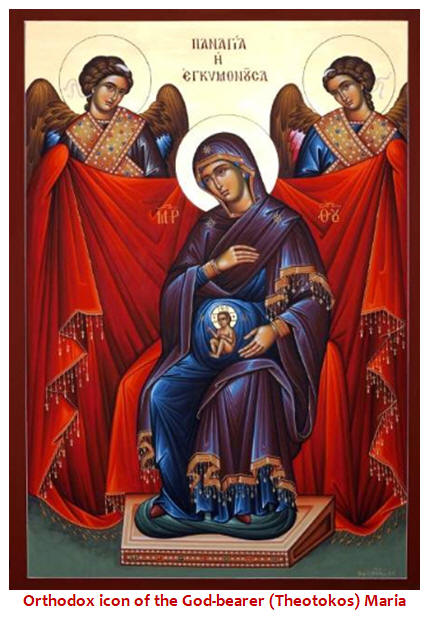
by PAPYRUS52
Responding to forgeries and timeless Protestant intolerances
against the Theotokos, the Ecumenical Councils and Cyril of Alexandria
|
The reason for the present article was to refute an argument of
Protestant origin, which attempts to present the teaching of the
Church as supposedly “altered”, by using as pretext the intense
personality of Cyril of Alexandria, who was known for his obstinacy,
impulsiveness and his excessive zeal.
There are assertions that essentially say this major theologian of
Christology1
could have “falsified” the dogma of the Church (!) – probably in
order to satisfy his personal ambitions or his ego: a slander that
borders on the absurd and of course is not substantiated anywhere...
What is worse, however, is that perfidy and resentment are not
confined to the person of Saint Cyril, given that assertions have
escalated to such a degree that even Ecumenical Councils are being
characterized as “corrupt”; in fact there have even been promptings
that the faithful should “be rid” of Conciliar teachings!
The term ‘Theotokos’ is about Christology, not “Mariology”
As regards the Christological term 'Theotokos', Saint Gregory the
Theologian - one of the major Fathers of the Church - wrote in 382
A.D. in his momentous first epistle 'To Cledonius':
“For
we do not isolate divinity from the man
(Christ);
but we dogmatize both as One and the same [...] and in the end,
enfleshed as a human for our salvation [...] so that being
refashioned as a whole man-and-God, He would fall under sin.
If one does not suppose the holy Mary as Theotokos, he is
without the divine'.2
And he adds:
“For,
that which is unaccepted is incurable; but that which is joined to
God, is saved.
3
Reading this profound theology, we wonder how Protestants have still
not comprehended that the term
'Theotokos' is not
'Mariology' 4 but Christology and Soteriology.
That which is united with God is saved, and that which is not united
with Him cannot be saved,
which is why “if one does not
admit holy Mary as the Theotokos, he is far from God”, as Saint
Gregory tells us.
Pursuant to the aforementioned, below is a segment of a Protestant
quote that evidences profound ignorance:
“In
the 5th century an Egyptian priest was reprimanded by
Nestorius... because he had described Mary, the mother of Jesus, as
“Theotokos” ... A vicious political struggle ensued, from which
Cyril had emerged victorious. From then on, that term became
a slogan.”
As we shall see, all this “information” is entirely out of place and
time...
Gregory the Theologian had written the above,
50 years before
the Ecumenical Council of Ephesus (431) and it is clearly evident
that he had considered the term
'Theotokos'
an integral part of the
Christological dogma, as a criterion that discerns Orthodoxy from
heresy. The
Protestant quote however misleads its readers, by referring to it as
just a “political
slogan” that prevailed somewhere “in
the 5th century” and something that we should “be
rid of ”!
Following the above, is it really
necessary to refer to the “deliberate
perversion by Protestants of the true meaning of the Orthodox
position regarding the truth about the Mother of the Lord'?5
Is the term 'Theotokos' biblical?
As usual, we can only wonder which Bible Protestants read, when they
assert beliefs such as “One
thing is certain – that the term “Theotokos” is a terrible word to
describe Mary. You can recognize it by its fruits. It's not biblical.”
As for the Church - which reads the Holy Bible very carefully – it
can clearly discern that Mary is the “God-bearer”, the gestator of
the Divine, given that She gave birth to God in the flesh:
(Matthew 1:16) Mary,
from whom Jesus, the so-called
Christ, was born.
(Matthew 1:18) And the birth of Jesus
Christ ... by His mother
Maria.
(Romans 9:5) Christ
according to the flesh, Who
is God above all.
Did the Protestants never see that
Mary actually bore and gave
birth to Christ, who is God? Since the Bible says that Mary gave
birth to God, why is the teaching of the New Testament shunned,
along with the denial that She is the God-gestator ?
Of course the handy excuse for their
disapproval is that when they hear the term Theotokos, their mind
instinctively recoils,
because it is led to the blasphemous notion that
God, who is uncreated, has a mother!
This, however, is not a problem of the Holy Bible but a Protestant
concern. Nowhere does the Holy Bible say that “the uncreated God has
a mother”! On the contrary, it clearly distinguishes that, “in
the beginning (of Creation)
was the Logos ... and
the Logos was God' (John 1:1); “all
things were made through Him” (John 1:3) and of course, “the
Logos became flesh” (John 1:14), “Christ in the flesh, who is
God above all” (Romans 9:5), “Maria, from whom Jesus was born, the
one called Christ” (Matth.1:16).
So we see that neither the Bible nor the Church are to blame; it is
the Protestant obsession with a delusion and the blinders that they
do not want to remove...
Protestantism and terms not in writing
As we pointed out, the term Theotokos is
imposed by the Holy
Bible itself, because it describes it explicitly - unless one
chooses to reject as forgeries Matth.1:16-18 and Rom. 9:5 (and many
others, of course, that testify as to the divinity of Christ). So it
would be prudent to abandon the ploy with “integral” words, which
clearly deceive followers.
But in order to better understand how shabby the ploy is (regarding
“non-biblical words” which we must “be rid of”), perhaps those who
are so “sensitive” about “integral» words (which by the way are also
used by Protestants), could tell us:
·
Where exactly is the (frequently used) term “uncreated”
found written in the Holy Bible?
·
Likewise, from which Biblical passage is the term “incarnate”
referenced?
From no Biblical passage is the answer. Both are
unwritten terms...
However, this doesn’t seem to discourage random commentators from
using unwritten terms at will, thus simultaneously appearing as
honorees on the one hand, while accusing others of supporting
“non-biblical terms” (which we have just shown are included and
imposed by the Holy Bible itself).
It would be quite interesting to see what even the Protestant
founder, Martin Luther himself, had written about the
Conciliar validation of
the term “Theotokos” (below are the key points in English):
“The
Council [=the
3rd Ecumenical of 431]
did not establish something
new in the faith, but only defended the old faith against the new
conception by Nestorius.
This article [=regarding
the Theotokos]
has existed in the church since the beginning; it was not
established recently by the Council,
but has been preserved through the Gospel or the
Holy Bible.”
[followed
by quotes of scriptural verses and concludes]: “These
[biblical]
texts (I am
convinced)
support quite consistently
that Mary is the mother of God.”6
If even Luther refutes Protestant commentators, what more can we
say?...
Can any authority whatsoever dictate the Doctrine?
'[...] a general named Marcian, who convened the Council of
Chalcedon. Time for revenge! […] ambition of a few reckless and
greedy people [...] [The 'Theotokos'] became part of the church
doctrine through a corrupt synod and a process of bribery and
corruption”...
Once again, we encounter here the old, familiar Protestant chime...
that the dogmas of the Church were supposedly “made” by emperors or
were designed to serve “groups” and “interests”...
Let’s begin with the Councils whose ecumenicity had been supposedly
rejected, but had nevertheless been supported, even under
persecutions by emperors:
-Council of Ephesus
(449 AD)
- Council of Hieria
(754 AD) -The unification Council of Ferrara-Florence (1438-9)7 The case of the Ferrara-Florence Council is especially important, as it proves - even after extreme conditions of pressure - that if even one first validation were to take place, it would be disregarded if it was not approved by all participants. That is why – in spite of the fact that all the Orthodox who were present had signed the Condition of the Council (with the exception of Bishop Mark of Ephesus), upon the return of the delegation, its recantation and conviction by the corpus of the Church had already begun, with consecutive conciliar decisions.8 However, apart from the above, there are irrefutable historical elements that demonstrate how arbitrary and unsupported Protestant theories are, about political or ecclesiastical groups that supposedly have the power at any time to “alter” the dogma of the Church in order to serve their personal interests: 1) From where is it deduced that ecclesiastic teaching could be changed to serve the interests of certain potentates, when we see that in the efforts of the omnipotent Constantine the Great to at least make peace with the Arians, the Church did not submit (with the persecution of the Orthodox as a result and a major example of which was the exile of Athanasius the Great?)9
2) From where is it deduced that
ecclesiastic teaching could be altered in order to serve the
interests of a few potentates, when we see that
the Church remained unyielding to the merciless persecutions of the
Arianists, who, during the
reign of the heretics Constantius and Valens, wanted to force the
Orthodox to accept the heresy of Arius?10
Arianism was in fact one of the most
powerful political and religious groups, which fiercely denied the
content represented by the term 'Theotokos' and used every means
possible to overturn the teaching of the Church,
but they
failed!
3) From where is it deduced that
ecclesiastic teaching could be altered to serve the interests of
certain potentates, when we see that
the Church remained unyielding to the increasingly harsh
persecutions of the pagan emperor Julian
(361-363 AD)?11
5) From where is it deduced that
ecclesiastic teaching could be altered to serve the interests of
certain potentates, when we see that
the Church had remained unyielding during the persecutions, tortures
and slaughters imposed on the Orthodox by the Iconoclasts for more
than one century?13
If the slanderous claim that pressures
could shape the teaching of the Church were true,
then the Orthodox should have first become Arianists, then pagans
(under Julian), then Monophysites, then iconoclasts and finally...
Uniates!
All the aforementioned prove once again
that talk of “powerful groups” and “corrupt Ecumenical Councils” is
nothing more than cheap vulgarity
against the Church...
Protestantism and morality However, given the manifest “sensitivity' regarding the morality of persons, let us take a look at the spirit of the founder and spiritual leader of the Protestants, Martin Luther, who considered that the 'Peasants' Revolution' (1524-25) endangered the religion he sought to create: “Furthermore, anyone who can be proved to be a seditious person is an outlaw before God and the emperor; and whoever is the first to put him to death does right and well. For if a man is in open rebellion, everyone is both his judge and his executioner; just as when a fire starts, the first man who can put it out is the best man to do the job […] Therefore let everyone who can, smite, slay, and stab, secretly or openly, remembering that nothing can be more poisonous, hurtful, or devilish than a rebel”..17 And if we were to bring up Luther's exhortations to violence against the Jews, matters get even worse: “What shall we Christians do with ... the Jews? ... I shall give you my sincere advice: First, to set fire to their synagogues or schools ... Second, I advise that their houses also be razed and destroyed.” (see his work, 'On the Jews and their lies,' 1543).18 We imagine that Protestants can realize the moral weight that these hateful sermons have - compared to other human passions. If human weaknesses can constitute an alibi for a commentator to overlook the importance of the theological struggles of so many centuries, we imagine that the violence depicted in the writings of the founder of Protestantism should have been capable of leading the faithful away from the religion that he founded... So, since they have not abandoned Luther, wouldn’t it be more honest to discuss - not a show of 'sensitivity' - but about a show of hypocrisy? As it is, Protestants disagree with the Church, which is why they left their former brothers, the Papists, and formed their own group. They disagree because they belong to another dogma, not because they are 'good' and 'moral'... They simply seek to conceal their disagreement in advance, using moralistic pretexts. Do they think they will fool others that their problem is supposedly human passions? Have such passions ever been absent from the Church? Already in the New Testament we see that human weaknesses are present - even in the apostolic circle, manifested as competition for primacy (Luke 22:24 ~ Mark 10:35-37), zealotism (Luke 9:54-55), personality worship (1 Cor. 1:12-13), tensions and conflicts (Acts 15:38-40 ~ Galatians 2:11-13), love of power and arrogance (III John 1:9).
This truth applies to every created person
who has passed through earthly life: “If
we say that we have no sin, we deceive ourselves, and the truth is
not in us” (1 John 1:8).
Abridged Chronicle of the Third Ecumenical Council: from the provocation by Nestorius to the Pacification of Conciliations (428-43)
The Beginning of the Dispute (428 AD) The entire controversy begins when Nestorius, Patriarch of Constantinople, preaches against the term 'Theotokos'. Essentially, Nestorius' close associate and advisor, Priest Anastasios, had proclaimed that Mary should not be called the Theotokos, because she was a human being and it is impossible for a human being to give birth to God. Nestorius “harbored” his partner and adopted this stance, by using the term 'Christotokos', arguing that the Virgin Mary gave birth only to the man Christ and not to God.19 This teaching provoked fierce reactions, with Cyril of Alexandria characterizing it as an 'ecumenical scandal'. 20 Cyril's First Reaction Initially, Cyril chose a mild approach, addressing a letter of plea to Nestorius and asking him 'to rectify his views', while at the same time, in the Paschal Epistle 17 of the year 429, he 'spoke out against his views without naming him'. 21 He also wrote 'a long encyclical letter 'to the monks in Egypt', refuting the heterodoctrine of Nestorius and providing the Orthodox meaning of the term 'Theotokos'22. This was followed by an exchange of letters with Nestorius in an attempt for theological dialogue and admonition, but with no result. 23 Internationalization and Conviction by Rome On seeing Nestorius' obsession and his arrogant responses, Cyril informs Pope Celestine of the situation. 24 Celestine convenes a synod in Rome in August of 430, which condemns Nestorius and authorizes Cyril to enforce the decision. 25 At the same time, Cyril informed about the events 'many bishops of the Eastern administration, especially John of Antioch26. The '12 Chapters' and the Convocation of the Council John initially seemed to understand Cyril, but his mood changed when in November 430 he received the Third Cyrillic Epistle to Nestorius containing the 12 Chapters (anathemas), which the Eastern Antiochians were also obliged to accept. At the time, mainly for reasons of prestige, the Easterners refused to agree and instead criticized that in Cyril's '12 Chapters' there was a latent Apollinarism and Monophysitism. 28 This further exacerbated the situation and Emperor Theodosius II 'accepted suggestions and on September 19, 430 he signed a 'divine letter', in which he called three bishops from each province to a Synod in Ephesus, for June 7, 431 (the day of Pentecost)' with the aim of resolving the dispute. 29 The imperial favor for Nestorius and the prejudice against Cyril A decisive factor that undermined the smooth process of the Third Ecumenical Council was the Emperor's misguided intervention. However, the Protestant commentary deliberately chose to ignore this factor, because the overlooking of the Emperor's responsibilities serves their ultimate goal, which is to more easily incriminate Cyril as the supposed root cause of the tensions. However, Cyril was in an unfavorable position from the beginning because, 'Nestorius, a young clergyman, educated, diligent, eloquent, respectable in life, but also obstinate, on ascending the throne of Constantinople in 428, had impressed the people of the capital from the first moment, with his sermons and his activities, also gaining the favor of the court'. 30' Emperor Theodosius II, influenced by the old quarrel between the Patriarch of Alexandria and the prefect [at the sad events of Hypatia] and because of his friendship with Nestorius, had the impression that Cyril had caused a disturbance with his intervention.' 31 At the same time, the emperor initiated the proceedings of the Council with a certain ulterior motive because, as an 'admirer of Nestorius', he aspired to 'the punishment or at least the humiliation of Cyril through the acquittal mainly of Nestorius. Cyril was certainly aware of these moods, but he could neither -nor did he want to- avert the Council, since he had characterized the cacodoxy of Nestorius as an 'ecumenical scandal'. 32 In addition to all the above, the emperor had information 'only from the reports of the one side, because Candidian [an official of the palace] was obstructing the transfer of Cyril's epistles to Constantinople'. 33 Commencement of procedures and the deposition of Nestorius (22 June 431) The beginning of the Council under Cyril was set for June 7, but was postponed to June 22 due to the delay of the Eastern bishops who announced that they would be further delayed and asked for the commencement to take place on June 26. The presiding Cyril rejects the postponement requested by the Easterners and the imperial representative, and decides to immediately begin the proceedings of the Council.34 The Synod ascertained Nestorius' disagreement with the Nicene Symbol and decided to depose him in absentia, a fact that provoked strong reactions from the Easterners and the emperor. 35 The rival Council of the Easterners (26/27 June 431) John of Antioch arrives delayed in Ephesus, refuses to participate in the Council of Cyril, and with the Easterners sets up his own Synod which proceeds with the deposing of Cyril and accuses the Council under Cyril of 'Apollinarist and Arianist deviations'. This action, which led to the creation of two opposing factions, was not due to the dogmatic identification of the Easterners with Nestorius, (given that most of them, led by John, accepted the term 'Theotokos') – but mainly due to the misinformation they had undergone from Nestorius himself and the imperial envoy, who had pushed them to the extreme. 36 The representatives of Rome (July 431) Later (July 9) the envoys of the Council of Rome also arrived, who the next day convened with those around Cyril and on July 11 signed the decisions of the Council without discussion, only after the reciting of the decisions (mainly the condemnation of Nestorius). At the same time, they proclaimed (on July 16-17) John of Antioch and 33 Eastern bishops as excommunicated. 37 The Imperial extortion (August-September 431) [and the Protestant deception] The Emperor, in a certainly non-canonical move - during which he validated the decisions of two rival groups as if that was the decision of one and only council - accepted the depositions of both sides (Nestorius, Cyril, bishop Memnon of Ephesus, associate of Cyril), placed them under confinement and imprisonment (!) through Count Ioannis, for the purpose of extorting a compromise. 38 In this predicament, Cyril is said to have resorted to the ploy of bribing members of the court to reverse (and he succeeded) the clime against him. 39 It is precisely at this point that the deceit of the Protestant commentary is revealed: It hastens to present – in an artfully incriminating manner – the epistle with the list of “gifts”, implying that it was 'somehow thus' that the term 'Theotokos' was established (!) but remains silent about the fact that Cyril had used the sending of gifts as a last resort of defence during a time of persecution. Also silenced is the fact that – in spite of the final removal of Nestorius and the release of Cyril (who was enthusiastically received by his flock) - the emperor ultimately failed to enforce any agreement between the two sides. 40 Finally, the end result is also cleverly silenced – that during the pursuant period, John of Antioch together with Cyril (the two leading figures of the opposing sides), with an extensive theological dialogue that lasted until 433 – finally reached an unforced pacification of the Church and the universal recognition of the Third Ecumenical Council. These were accepted by everyone and announced with epistles throughout universal Orthodoxy with joyful expressions such as: “Piety has prevailed, and every envy of the devil is gone [...] We therefore gladly accept the agreement of the pious confession and with it the peace of the Church.” 41 But by not willingly acknowledging all these events, the Protestant position resorts to propagandizing techniques, by presenting certain actual elements in a distorted manner, and finally constructing a historical falsity... Negotiations for peace and the “Formula of Union” (April 433) Consequently, after the tensions, a long period of consultations followed, with Bishop Paul of Emesis assuming the role of mediator between Alexandria and Antioch. 42 Cyril, showing conciliation, agrees to not insist on his own theological terms for the sake of peace, thus paving the way for reconciliation. 43 The process ends with the acceptance of the condemnation of Nestorius by John of Antioch and the acceptance of the Confession of Faith of the Easterners by Cyril. Peace is sealed with the epistle by 'Cyril, Bishop of Alexandria, to John': “My Lord, dear brother and concelebrant John, with Cyril rejoice in the Lord. Let the heavens rejoice and let the earth rejoice, for the middle wall of the barrier is undone, and the sorrowing has ceased..”. 44
The “Formula of Union”, which “became the
official dogmatic 'Oros' (condition) of the Third Ecumenical
Council”
45, was the product of
free will and theological convergence, with its aim the unity of the
Church and in no case “a political victory of one side with
insidious methods”, according to Protestant assertions.
The Conciliatory and Ecclesiastical Conscience of Cyril of
Alexandria: debunking the Protestant myth of the 'ambitious social climber '
The first mild approach to Nestorius According to Protestants’ extreme positions, the word “Theotokos” was the tool supposedly used by Cyril in an attempt for supremacy. It is a given fact, however, that such views have nothing to do with reality, because a reasonable question arises here: What behavior would one expect from a man who (according to his accusers) is dominated by the thirst for power and the vanity to impose himself? Wouldn't he have seen Nestorius' error as an opportunity for an immediate rupture, without any interest in margins for a dialogue? What does Cyril actually do? The exact opposite. He sends a low-key epistle, in which he addresses Nestorius thus: “To the most pipous and most reverend bishop and concelebrant, Nestorius” 46! As prof. Panagiotis Christou writes: “This teaching, made known to Alexandria through the permanent representatives of Alexandria’s Cyril in the capital city, initiated Cyril's reaction, which initially was mild - albeit there already being a misunderstanding between the two patriarchs on account of the Egyptian monks who sought refuge in Constantinople'. 47 And as noted by prof. John Karmiris, in his first letter to Nestorius, Cyril addressed him “fraternally beloved” that he might rectify his teaching “to put an end to the ecumenical scandal”. 48 So, if Nestorius had replied that his words had simply been misunderstood, the whole matter would have ended there, and Cyril's supposed “opportunity” would have been lost... Consequently, we have the historical evidence that Cyril did not seek rupture. If it were differently, such a serious issue, a Christological 'ecumenical scandal' would have been a unique opportunity for a 'social climber ' to clash.
Let readers therefore judge the extremes
of the Protestant position that seeks to portray Cyril of Alexandria
as someone who was “looking for an opportunity to attack”, when the
historical evidence shows that despite the theological criticality
of the issue, he was
merely consumed with attempts of
admonition...
The term 'Theotokos' in Cyrillic Christology prior to Nestorianism
As mentioned,
'in 428 the 'ecumenical
scandal' broke out with the denial of the term Theotokos by
Nestorius'. 49
Cyril of Alexandria, however, had already been using the term
'Theotokos' in his memorandum on the prophet Isaiah which was
written somewhere
'between 412 and 418'.
50
In it was written:
“For it was the blessed
(angel) Gabriel who had
disclosed the Mystery (of the divine conception)
to the
holy and (God-bearing)
Theotokos virgin”.
51
In fact, in this text he also uses his own, par excellence dogmatic,
Christological term,
ισοκλεής52
(equal in glory), which he repeatedly uses in his works
written before 428,
precisely in order to describe
the godhood of the incarnate
Christ, Who is true God, equal to the Father:
“In
the Christ all shall
be vivified [...] (He is) able to work as equal to God, surely
equal in glory, and He
is nothing other than God”.
53
Consequently, the Protestant claim that Cyril adopted the term
'Theotokos' with the aim of starting a 'political struggle' is
refuted. This term was already established in his works before the
beginning of the Nestorian controversy (428) and was an organic part
of his theological teaching, being inextricably linked to
Christology and the Soteriology of the Church.
Besides, we have already recorded the
biblical foundation of
the term 'Theotokos' (Matthew 1:16-18 & Romans 9:5), but also by
Ignatius of Antioch, who
speaks of
'Christ the God',
'truly born of a Virgin'
(Epistle 'to the Smyrnaeans' 1:1), proving the apostolic nature of
the teaching. The term 'Theotokos' is used by
Gregory the Wonderworker
(213-270),54
while we have also presented the importance that Saint Gregory the
Theologian had ascribed to the term.
In fact it is also worth adding an important
exo-Christian testimony,
from the pagan emperor Julian (!) who indirectly documents the
honorific status that the Theotokos had in the Christian community,
70 whole years before Nestorianism, by writing:
'And do not cease to call
Maria “Theotokos” ('Against Galileans', 262d).
Thus, historical evidence shows that the term 'Theotokos' – either
as a word or as a meaning – was already established
long before Nestorianism55
appeared, hence the only thing that Cyril of Alexandria did was to
defend an already established dogmatic term. In fact, he himself
clearly notes that it is a Scriptural and Patristic term:
'As for the Theotokos Virgin, as we believe and say, of the manner
of the incarnation, of the only-begotten Son of God, it is necessary
- not as an addition, but as a kind of information -
that we received it from
above, both in the divine Scriptures and the tradition of the holy
Fathers'.
56
And yet, the Protestant commentary speaks of a 'slogan' of the '5th
century' that we should 'be rid of'...
The publicly expressed remorse with the recognition of the prestige
of Chrysostom
This definitely shows “a
change in stance and an appreciation of the theological thought of
Chrysostom”59.
Above all, however, this
public acknowledgment refutes Protestant criticism and proves that
Cyril had the spiritual stature to place the truth of the Church
above passions and egotisms.
The acceptance of the “Formula of Union”as evidence of moderation
This predisposition in favor of peace was also verified with the “admirable
spirit of moderation” that he displayed, given that he “repeatedly
embarked on interpreting certain expressions in his writings, so
that they would be accepted by the Antiochians”.
60
Without sacrificing the essence of ecclesiastical teaching of
course, Cyril made brave
concessions in order to achieve the conciliatory “Formula of
Union”, so that the upright faith could be confessed even without
his own terminology. 61
Consultations continued and in 433 a confession by Cyril (PG 77,
69A) was delivered to John of Antioch, a part of which had been sent
by the “rival” Antiochians. John signed the confessional text that
went down in history as the “Formula of Union” and was accepted as a
dogmatic decree (“Oros”) of the Third Ecumenical Council.
At Easter of 433, Cyril announced the agreement of the
Formula of Union 62,
proving once again that nothing could be evaluated as higher than
the truth and the unity of the Church.
The magnanimity and high moral stance of Cyril of Alexandria
In closing, we shall give the floor to Patrology Professor Stylianos
Papadopoulos, who restores the historical truth by documenting the
virtues and the ethos of Cyril of Alexandria, elements that
Protestantism stubbornly refuses to acknowledge:
“In the years that followed,
Cyril continued to project his theology, but was always concerned
with the peace of the Church. He upheld and applied 'Oekonomia’
(Ecclesiastic Economy) and not
'Akriveia’ (Precision), on a case-by-case basis. Albeit
having written a work “Against Diodorus and Theodorus”, at the
Council of Jerusalem (439)
he considered their Conciliar conviction as unnecessary, given
that both had died in the bosom of the Church.
Characteristic of Cyril's
generosity and prudence is that his work 'Against Julian' was sent
for judging by his old rival, John of Antioch. But he also sent
works to Theodoret of Cyrus 'many times', as the latter attests, who
also generously praises Cyril, describing him as 'blessed'.
The Churches everywhere
honored Cyril extremely and acknowledged his theological
precedence, confessing in various ways his unique contribution to
the solution of the Christological problem at the time.”
63
However, none of the aforementioned details can be found in any
serious Protestant commentary – not even the conclusion of the
story, where “the
matter of distance was settled”
64 and that
with joy and exultation the pacification and agreement of the Church
were finally achieved!
Obviously this development - with the
“Formula of Union” definitively sealing the unity of the Church –
has overturned all narratives by any prejudiced commentators who
choose to slander instead of inform.
Such futile attempts can only mean
that negative or even hostile opinions are circulating freely in the
hope of projecting a moral advantage of the Protestant sphere over
the Church; if serious researchers would take the time to study all
the available official reports of all the pertinent events, they
would discover the truth of the One Church, and avoid blind
fanaticism and intolerance, thus helping the truth of the Church to
shine even brighter...
********************************
Footnotes:
1
Papadopoulos
Stylianos , «Patrologia
», Vol. 3,
Grigoris, Athens 2010, page 469.
2 Gregory
the Theologian , «Epistle
ro Cledonius the presbyter,
Against Apollinarius», No. 90 (101),
PG
37,177
BC.
3
«Epistle
to Cledonius...…»,
PG
37,181C.
4
See:
Passakos Demetrios , «Theology
and communion in dialogue. New Hermeneutical Approaches in the New
Testament', Pournaras, Thessaloniki 2001, page 136: The teaching on
the Theotokos is an integral part of 'Christology, that is, of
Trinitarian theology. For this reason, the Orthodox never formulated
a 'mariology', but a teaching about the 'Virgin Mary' with extremely
important anthropological importance.'
5
See:
entry «Μαρία»,
Religious and Moral Encyclopedia (ΘΗΕ),
Vol. 8 (1966), verse 681.
6 Luther
Martin, «Luther's Works»
(J. J. Pelikan, H. C. Oswald & H. T. Lehmann επιμ.), Vol.
41 (Church and Ministry
III), Fortress Press, Φιλαδέλφεια 1999,
page
105: «Well then, this council
too did not establish anything new in faith, as we said above, but
only defended the old faith
against the new notion of Nestorius, so one cannot take any
examples from it, or give the councils authority to establish new or
different articles of faith. This article was in the church from the
very beginning and was not newly established by the council, but was
preserved through the gospel or Holy Scripture, for it is written in
Luke 1 [:32] that the angel Gabriel announced to the Virgin Mary
that of her would be born “the Son of the Most High.” And St.
Elizabeth, “Why is this
granted me, that the mother of my Lord should come to me?” [Luke
1:43]. And at Christmas all the angels, “To you
is born this day a Savior,
who is Christ the Lord” [Luke 2:11]. And in Galatians 3 [4:4] St.
Paul, “God sent forth his
Son, born of woman.” These texts (I am convinced) hold firmly
enough that Mary is the
mother of God».
7
On
these Synods,
see: Pheidas
Vlasios, «Ecclesiastic History»
, Vol. 1,
, page 867
και
Vol. Β',
page 624.
8
See:
details in an old (Greek) article,
here.
9
Pheidas Vlasios,
«Ecclesiastic History»
, Vol. 1, page 478-483.
10
See: Gregory the
Theologian , «To Heron the philosopher», PG 35,1209 B-1212 A ~
Socrates Scholastikos «Ecclesiastic History»
, PG 67, 272Β
- 273Α
~ Ioannis Anastasiou, «Ecclesiastic History»
, Vol. 1, page 238 ~
Ioannis Karayannopoulos, «History of Byzantine State», Vol.
1, page 146.
11
See: Gregory the
Theologian , «Against Julianus, king», PG 35, 532 etc. and PG 35,
664 etc.
12
See: Article by
Gerasimos Konidaris, «Relations of Church and State», Religious and
Moral Encyclopedia , Vol.4 (1964), verse 4 ~ Ioannis Anastasiou,
«Ecclesiastic History»
, Vol. 1, pages 374-375 ~
Despina Kontostergiou, «the Ecumenical Synodsι»,
page 116.
13
Ioannis Karayannopoulos, «History of Byzantine State», Vol.
Β',
pages 157,161 ~ Georg Ostrogorsky, «History of Byzantine State»,
Vol. Β',
pages
41-42.
14
See: Religious
and Moral Encyclopedia , Vol. 4
(1964), verse 4 ~ Nikolaos Matsoukas, «Dogmatic and Symbolic
Theology», Vol. 3, pages 297-298.
15
On the works of the satan-driven iconoclast emperors and especially
of the bloodthirsty Constantine V, see: Theophanes, 'Chronography':
'And he eliminated many
of the monks with whips, and there were some by the sword, and
innumerable were those blinded. And to others he smeared their
beards with wax oil, and set fire to them' (PG 108, 900B).
You have exceeded all the
evil ones, but not more than Diocletian and the tyrants of old'
(PG 108,905A).
16
See:
«Church and State in the Byzantine Empire. A Reconsideration of the
Problem of Caesaropapism»,
στο
«Church History», Vol.
34, No. 4, (December 1965),
page
381: «As we have shown, the
emperor was never able successfully to penetrate into the church's
inner core, the more spiritual form relating to dogma and the
sacraments».
17
Luther Martin, «Luther's
Works» (J. J. Pelikan, H. C. Oswald & H. T. Lehmann
επιμ.),
Vol.
46, Fortress Press,
Φιλαδέλφεια
1999 (c1967),
page
50: «Furthermore, anyone who
can be proved to be a seditious person is an outlaw before God and
the emperor; and whoever is
the first to put him to death does right and well. For if a man
is in open rebellion, everyone is both his judge and his
executioner; just as when a fire starts, the first man who can put
it out is the best man to do the job […]
Therefore let everyone who
can, smite, slay, and stab,
secretly or openly, remembering that nothing can be more
poisonous, hurtful, or devilish than a rebel».
18
Luther Martin, «Luther's
Works» (J. J. Pelikan, H. C. Oswald & H. T. Lehmann
επιμ.),
Vol.
47, Fortress Press,
Philadelphia
1999 (c1971),
page
268: «What shall we
Christians do with ...
the Jews? ... I shall
give you my sincere advice: First,
to set fire to their
synagogues or schools ...
Second, I advise that their
houses also be razed and destroyed».
19
Karmiris Ioannis, «The
Dogmatics
and the symbolic monuments of the Orthodox Catholic Church»,
Vol. 1,2nd ed., Athens 1960, page 135: «…about
the Virgin which had given birth to the ‘mere man Christ’.
The term ‘Theotokos’ was dismissed (by
Nestorius)
as non-biblical […] consequently also
dismissing the title ‘mother of God’, lest one makes ‘ the
virgin a goddess’»
20
Papadopoulos
Stylianos , «Patrologia
», Vol. 3, page
378.
21
Christou
Panayotis, «Hellenic
Patrologia », Vol.
4 , 2nd ed., Kyromanos,
Thessaloniki 2006, page 436.
22
Karmiris
Ioannis, «The Dogmatics …»,
Vol. 1, ,
ibid,page 138.
23
Christou
Panayotis, «Hellenic
Patrologia », Vol.
4 , ibid,page 343.
24
Christou
Panayotis, «Hellenic
Patrologia », Vol.
4 , ibid,page 379.
25
Papadopoulos
Stylianos , «Patrologia
», Vol. 3,
ibid,page 394.
26
Papadopoulos
Stylianos , «Patrologia
», Vol. 3,
ibid,page 379.
27
Papadopoulos
Stylianos , «Patrologia
», Vol. 3,
ibid,page 379.
28
Karmiris
Ioannis, «The Dogmatics …»,
Vol. 1, ,
ibid,page 142-3.
29
Papadopoulos
Stylianos , «Patrologia
», Vol. 3,
ibid,page 379.
30
Christou
Panayotis, «Hellenic
Patrologia », Vol.
4 , ibid,page 342.
31
Kyrillos,
RME -RELIGIOUS AND MORAL ENCYCLOPEDIA 7 (1965), verse 1163.
32
Papadopoulos
Stylianos , «Patrologia
», Vol. 3,
ibid,page 389.
33
Christou
Panayotis, «Hellenic
Patrologia », Vol.
4 , ibid,page 345.
34
Papadopoulos
Stylianos , «Patrologia
», Vol. 3,
ibid,page 380.
35
Papadopoulos
Stylianos , «Patrologia
», Vol. 3,
ibid,page 382.
36
Papadopoulos
Stylianos , «Patrologia
», Vol. 3, page
382-383.
37
Papadopoulos
Stylianos , «Patrologia
», Vol. 3, page
382.
38
Papadopoulos
Stylianos , «Patrologia
», Vol. 3, page
385,390.
39
Schwartz
Eduard,
ACO,
Concilium
Universale
Ephesenum
1.4,2,
Walter
de
Gruyter
&
Co.,
Berolini
1922, pp.224-225.
40
Christou
Panayotis, «Hellenic
Patrologia », Vol.
4 , ibid,page 346.
41
Schwartz
Eduard,
ACO,
Concilium
Universale
Ephesenum
1.1.7, ibid,1929, page 156.
42
Karmiris
Ioannis, «The Dogmatics …»,
Vol. 1, ,
ibid,page 147.
43
See:
Papadopoulos Stylianos , «Patrologia
», Vol. 3,
ibid,page 498.
44
Schwartz Eduard, ACO,
Concilium Universale Ephesenum 1.1.4, ibid,1928, page 15.
45
Karmiris
Ioannis, «The Dogmatics …»,
Vol. 1, ,
ibid,page 150.
46
Karmiris
Ioannis, «The Dogmatics …», Vol. 1,
, ibid,page 138.
47
Kyrillos,
RME -RELIGIOUS AND MORAL ENCYCLOPEDIA 7 (1965), verse 1162.
48
Karmiris
Ioannis, «The Dogmatics …»,
Vol. 1, ,
ibid,page 138.
49
Papadopoulos
Stylianos , «Patrologia
», Vol. 3,
ibid,page 470.
50
Papadopoulos
Stylianos , ibid,page 541.
51
Kyrillos
of Alexandria, «Exegesis on
the prophet Isaiah», PG70,1036 D.
52
Ibid,PG70,1036
C.
53
Kyrillos
of Alexandria, «On the holy
and cosubstantial Trinity», PG75,841
C.
54
«On the Annunciation of the
Most Holy Theotokos and Ever-Virgin Maria», PG 10,1168
Α-1169
C: “For
having made me a God-bearer (Theotokos),
He preserved me as a virgin again, and through my womb is the
fulfilment of all
generations summed up.”
55
For
the pre 428 testimonies on the term «Theotokos» see:
Stamoulis Chrysostomos, «Theotokos
and the orthodox dogma. A
study on the teaching of Saint Cyril of Alexandria», 2nd
ed. “The Palimpsest”
publishers, Thessaloniki 2003, pages 153-158.
56
Epistle 39, PG 77,176 CD.
57
Kyrillos, RME -RELIGIOUS AND MORAL ENCYCLOPEDIA 7 (1965), verse
1162.
58
K.N. Papadopoulos, «The Church of Egypt on Saint John the
Chrysostom», Kleronomia 28.1‑2 (1996), page 279. See:
‘use of Chrysostom in
Mansi
4,693CD
as well as critique on Nestorius,
PG
77,65C.
59
Papadopoulos
Stylianos , «Patrologia
», Vol. 3,
ibid,page 536.
60
Kyrillos,
RME -RELIGIOUS AND MORAL ENCYCLOPEDIA 7 (1965), verse 1164.
61
See:
Papadopoulos Stylianos , «Patrologia
», Vol. 3,
ibid,page 498.
62
See:
Papadopoulos Stylianos , «Patrologia
», ibid,page 499.
63
See:
Papadopoulos Stylianos , «Patrologia
», ibid,page 538.
64
Karmiris
Ioannis, «The Dogmatics …»,
Vol. 1, ,
ibid,page 135.
|